It's Good To Be Cared For. It's Great To Be Cared About!


Are elder care franchises profitable? They can be, but home care franchise profitability depends far more on how the agency operates than on revenue alone. The biggest financial drivers are typically billable care hours, client billing rates, caregiver labor costs, caregiver and client retention, recruiting efficiency, and overhead.
That means a home care agency can increase revenue without necessarily becoming more profitable. If caregiver overtime, recruiting costs, administrative payroll, or unfilled shifts rise faster than billable hours, margins can shrink even as sales grow.
For someone considering a senior care franchise, the better question isn’t simply, “How much can a home care franchise make?”
It’s this:
How efficiently can the business turn demand for home care into consistently staffed, profitable hours?
Understanding that equation can give you a much clearer picture of elder care franchise profitability—and what separates a growing home care agency from one that simply generates a lot of revenue.
A non-medical home care franchise generally earns revenue by arranging and providing caregiver services for clients who need assistance at home.
The basic economics can be thought of this way:
Billable Care Hours × Average Client Billing Rate = Gross Revenue
Gross Revenue − Direct Cost of Providing Care = Gross Profit
Gross Profit − Operating Expenses = Operating Profit
The formula looks simple. Running the business well enough to make that formula work is where the real opportunity—and challenge—lies.
Caregiver compensation is a major direct cost, while expenses such as administrative payroll, recruiting, marketing, insurance, technology, franchise fees, and other overhead affect what remains after gross profit. That’s why two home care agencies with identical annual revenue can have very different financial results.
Instead of focusing on a single “average home care franchise profit margin,” prospective owners should understand the individual levers that affect profitability.
| Profitability Lever | Why It Matters |
| Billable care hours | More successfully staffed hours generally create more revenue |
| Client billing rate | Determines how much revenue each hour of care generates |
| Caregiver labor costs | Directly affect the margin generated on each billable hour |
| Unfilled shifts | Represent demand the agency may be unable to convert into revenue |
| Overtime | Can cause labor expenses to rise faster than revenue |
| Caregiver retention | Helps preserve staffing capacity and reduce constant recruiting pressure |
| Client retention | Longer relationships can increase lifetime client value |
| Referral relationships | Can create a recurring pipeline of prospective clients |
| Administrative overhead | Determines how much gross profit ultimately reaches the bottom line |
| Territory penetration | Determines how effectively the agency captures available local demand |
This is a more useful way to evaluate a home care franchise investment because it reveals something a top-line revenue number can’t:
How efficiently is the business actually operating?
Consider a simplified example.
A family hires an agency to provide 30 hours of non-medical home care each week. The agency charges the client an hourly rate and compensates the caregiver who provides those 30 hours of service.
The difference between the client billing rate and the direct cost of providing that care contributes toward gross profit. The agency then uses gross profit to cover other business expenses.
Multiply that process across dozens—or eventually hundreds—of clients and caregivers, and you begin to see how a home care agency scales.
But there is an important wrinkle: The agency can only bill for care it actually delivers.
If a family requests 40 hours of weekly care and the agency doesn’t have a caregiver available to accept the case, the demand exists—but the revenue doesn’t. That’s why staffing capacity is directly connected to revenue capacity in home care.
If you’re researching how much senior care franchise owners make, don’t let these terms get blurred together.
Revenue is the total amount generated by the business before expenses.
If an agency generates $1 million in annual billings, it has approximately $1 million in revenue. The owner did not “make $1 million.”
Gross profit reflects what remains after accounting for direct costs associated with providing care.
For a home care agency, caregiver labor and related employment expenses can represent a significant portion of those direct costs.
Operating profit is what remains after additional expenses required to operate the business.
Those may include administrative payroll, recruiting, insurance, technology, marketing, franchise royalties, office expenses, and other overhead.
This distinction is essential when comparing home care franchise profit margins or Financial Performance Representations from different franchise systems.
Always ask: “Is this number revenue, gross profit, or bottom-line profit?”
Those are very different things.
Prospective franchisees should evaluate financial performance using Briggs Home Care’s current Franchise Disclosure Document and Financial Performance Representation rather than relying on generic home care industry estimates.
Briggs Home Care currently reports average gross annual revenue of approximately $1.47 million for a Briggs Home Care franchise.
That figure is revenue—not guaranteed owner income or net profit.
Individual results can vary significantly based on market conditions, operating expenses, labor costs, number of clients, billable hours, business maturity, and the owner’s execution.
This is an important distinction because prospective franchisees shouldn’t evaluate an opportunity based solely on the largest number on a franchise website.
The more useful questions are:
The current FDD and Item 19 should be your primary sources for answering those questions.
There is no universal home care franchise owner salary.
Owner income can depend on annual revenue, operating margins, debt, local labor costs, business maturity, staffing structure, and how actively the owner works in the business.
Compensation can also be structured differently.
An owner might take a salary for managing the agency, receive distributions from business profits, reinvest profits into expansion, or use some combination of the three.
That’s why searches for “average home care franchise owner salary” can produce misleading answers.
The more meaningful metric is the economics of the individual agency.
Home care is ultimately an hours-driven service business. Client count is useful, but it doesn’t tell the full story. Ten clients receiving five hours of care each week represent 50 weekly billable hours. Ten clients receiving 30 hours each represent 300. Same number of clients. Completely different revenue opportunity.
Owners should therefore understand metrics such as:
An agency that steadily grows recurring, successfully staffed hours is building a much stronger revenue foundation than one focused only on lead volume.
This is one of the most overlooked components of home care profitability. Most businesses think of recruiting as an expense. In home care, recruiting can also be a growth constraint.
Imagine receiving calls from three families that collectively need 100 hours of care per week. If you can only staff 40 of those hours, marketing isn’t your biggest problem.
Capacity is.
A strong caregiver recruiting system helps an agency convert more demand into actual care—and actual revenue.
Recruiting caregivers only to lose them quickly creates a costly cycle. Turnover can require additional advertising, interviewing, onboarding, training, scheduling changes, and administrative time. It can also affect client relationships.
Caregiver retention therefore has two sides to it: cost control and revenue protection. A reliable caregiver workforce gives an agency greater confidence that it can accept new clients and continue serving existing ones consistently.
The spread between what an agency charges for care and what it costs to deliver that care is fundamental to gross margin. But simply raising rates isn’t a profitability strategy.
An agency must remain competitive within its local market while offering compensation capable of attracting dependable caregivers.
That creates an important balancing act:
Strong operators understand both the customer and labor sides of their local market.
Not all clients have equal financial value.
Consider two hypothetical cases.
The sales effort required to acquire each client may be similar, but their lifetime revenue potential is dramatically different.
Longer client relationships can make acquisition efforts more efficient and create a more predictable base of recurring billable hours. This connects quality of care directly to business performance.
Satisfied families may remain clients longer, expand care as needs change, and recommend the agency to others.
Home care can be an intensely local, relationship-driven business.
Digital marketing may generate inquiries, but professional referral relationships can become another important source of client opportunities.
Potential referral partners include:
The goal isn’t simply to collect business cards.
It’s to become a trusted local resource when someone encounters a family that needs help at home.
A diverse referral network can create a healthier client-acquisition engine than relying entirely on paid advertising.
A large senior population does not automatically equal a great home care market.
A prospective franchise owner should evaluate both demand and supply.
On the demand side:
On the supply side:
You need families seeking care and people available to provide it.
Growth can hide inefficiency. An agency may celebrate rising revenue while simultaneously experiencing higher overtime, excessive recruiting costs, unnecessary administrative payroll, poor scheduling, or increasing client churn.
Eventually, those problems catch up. Successful operators should monitor the relationship between growth and cost—not simply growth itself.
Understanding what destroys margin can be just as valuable as understanding what creates it.
Some common warning signs include:
The client wants the service, but the agency can’t provide the caregiver.
That’s revenue left unrealized.
Filling every shift is important, but consistently relying on overtime can make those hours more expensive to deliver.
Constant replacement recruiting can increase costs while creating operational instability.
Pricing that doesn’t keep pace with caregiver wages and other operating costs can slowly compress margins.
A geographically scattered client base can create inefficient caregiver travel and scheduling challenges.
Constantly replacing departing clients means continually spending resources to replace lost billable hours.
Paid marketing can be valuable, but relying entirely on purchased demand may increase customer acquisition costs.
Hiring administrative staff ahead of revenue can place unnecessary pressure on a young agency.
This is why the healthiest growth isn’t necessarily the fastest growth.
It’s growth that becomes increasingly repeatable and operationally efficient.
The economics of a franchise matter, but so does the market behind it.
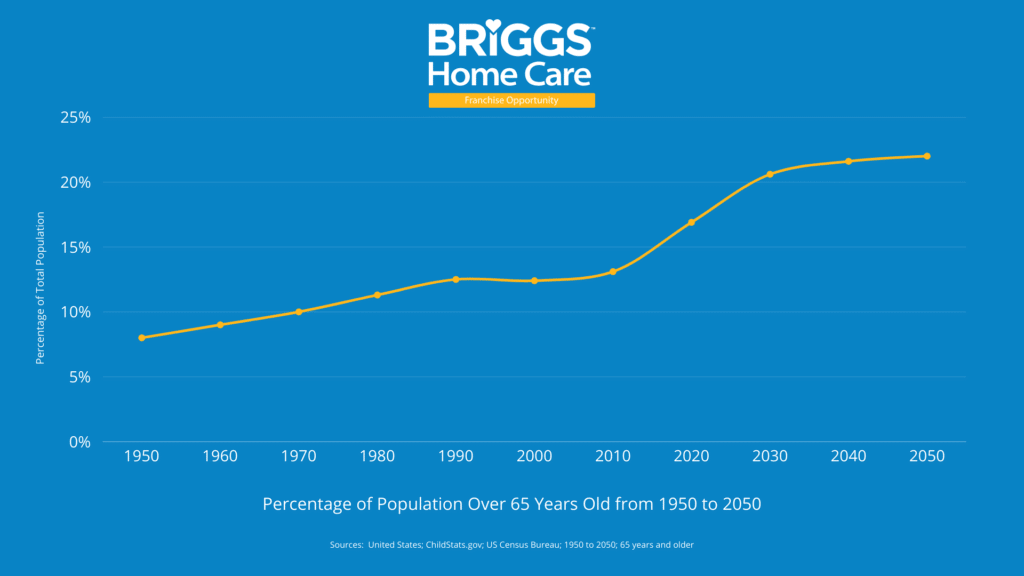
America is aging.
By 2030, every member of the baby-boom generation will be older than 65, and approximately one in five Americans is projected to be retirement age.
At the same time, families increasingly need help supporting older loved ones who want to remain at home.
That demand can include assistance with:
The workforce data tell a similar story. Home health and personal care aides are among the country’s fastest-growing and highest-demand occupations.
But there’s a business lesson hidden inside that growth:
More demand for caregivers also means agencies need effective recruiting and retention systems.
An aging population can create an expanding market for care while simultaneously making caregiver capacity increasingly important.
A non-medical home care business generally doesn’t require the same physical infrastructure as a restaurant or traditional retail concept.
There’s no dining room. No commercial kitchen. No warehouse full of consumer inventory. No prime retail storefront required to generate walk-in traffic. Instead, capital is primarily being invested into building a service organization. That can reduce certain fixed costs, but it doesn’t make home care a passive or “easy” franchise.
People are the infrastructure. Your caregivers, administrative team, referral relationships, operating systems, reputation, and local leadership ultimately determine how well the organization performs.
Home care has the potential to generate recurring revenue because many clients need assistance week after week rather than making a one-time purchase. But “recurring” should not be confused with “guaranteed.”
A client’s needs can increase, decrease, or end. That makes both new-client acquisition and client retention important. The healthiest agencies continually develop new referral opportunities while maintaining strong relationships with existing clients. Over time, that can create a base of recurring weekly billable hours while new cases add incremental growth.
There is no responsible universal answer. A new agency needs to build two things simultaneously:
A client base.
And a caregiver base capable of serving it.
During the early stages, expenses such as recruiting, marketing, insurance, administrative support, franchise fees, and technology can exist before enough billable hours have accumulated to cover them.
Break-even therefore depends on factors including:
Be cautious of any source promising that every home care franchise becomes profitable within a specific number of months.
The better approach is to review the franchisor’s Financial Performance Representation and discuss actual ramp-up experiences with existing franchisees.
Item 19 of the Franchise Disclosure Document is where a franchisor may provide a Financial Performance Representation.
For anyone researching senior care franchise profitability, this section deserves careful attention.
Don’t just look for the biggest revenue figure.
Ask:
Averages can be useful.
Context makes them meaningful.
Briggs Home Care currently lists an estimated initial investment range of approximately $97,285 to $146,440.
That puts the concept in a very different capital category from franchises requiring expensive restaurant construction, specialized equipment, or significant physical inventory.
However, initial investment should never be evaluated independently of ongoing operating expenses and franchise fees.
Prospective owners should review the current Briggs Home Care FDD for the complete investment range, franchise fee, royalty, required marketing expenditures, working-capital assumptions, and other costs before making an investment decision.
If you’re comparing senior care franchise opportunities, financial potential is only part of the decision.
You’re also choosing the system behind the numbers.
Briggs Home Care is backed by a leadership team with decades of combined experience in home care and healthcare.
The franchise model is designed to help owners develop several of the capabilities that directly influence home care growth:
Because caregiver capacity can determine how many cases an agency can accept, recruiting and training aren’t secondary support functions. They’re central to the business.
Briggs helps franchisees build local referral relationships designed to create awareness among professionals and organizations that encounter families needing home care.
Territory structure gives franchisees a defined market in which to develop their business and local relationships.
Owners enter an established operating system rather than having to develop every process independently.
Home care is not simply another service franchise category. Operating within a healthcare-adjacent environment requires understanding families, caregivers, referral partners, service quality, and the needs of older adults.
That broader experience is an important consideration when comparing franchise systems.
A strong franchise evaluation goes well beyond asking, “How much can I make?”
Ask the franchisor:
And then do something equally important:
Talk to existing franchise owners.
Ask them what surprised them, what was harder than expected, which support they use most, how their business changed as it grew, and what they wish they had understood before opening.
If you’re researching elder care franchise profitability because you’re considering entering the home care industry, your next step should be deeper due diligence.
Briggs Home Care offers entrepreneurs an opportunity to build a local home care business with the backing of an established healthcare organization, extensive industry experience, training, operational resources, marketing support, and a system designed specifically for the home care market.
Explore the Briggs Home Care franchise opportunity to learn more about available territories, investment requirements, financial performance information, and what it takes to become a franchise owner.
Elder care franchises can be profitable, but results vary by franchise, territory, labor costs, client billing rates, billable hours, caregiver availability, operating expenses, and owner execution. Revenue alone does not determine profitability. Prospective owners should review the franchise’s current FDD and Item 19 Financial Performance Representation for franchise-specific information.
There is no universal home care franchise owner salary. Owner earnings depend on the agency’s revenue, expenses, business maturity, local market, staffing model, debt, and how the owner chooses to compensate themselves. Revenue, business profit, and owner income are three different measurements.
Home care franchise profit margins vary significantly by agency and by how “profit margin” is defined. Gross margin measures something different from operating or net margin. Caregiver labor, recruiting, administrative payroll, franchise fees, marketing, insurance, technology, and other expenses can all affect the final margin.
A home care agency generally charges clients for hours of care and compensates caregivers for providing those services. The difference between revenue and direct care costs contributes toward gross profit. Additional operating expenses are then deducted to determine operating profitability.
Major profitability drivers can include recurring billable hours, appropriate client pricing, caregiver utilization, controlled labor costs, strong caregiver and client retention, efficient recruiting, referral relationships, and disciplined overhead management.
Caregiver labor and associated employment costs are typically among the most significant direct expenses in a home care agency. That makes scheduling, utilization, overtime, recruiting, and caregiver retention important financial considerations.
Billable hours are hours of care that an agency successfully provides and bills to a client or payer. They are an important operating metric because having more clients doesn’t necessarily mean more revenue if those clients use relatively few hours of care.
There is no standard break-even period for every home care franchise. The timeline depends on startup expenses, how quickly clients are acquired, caregiver availability, billable hours, pricing, marketing, labor expenses, and overhead. Prospective owners should review franchise-specific disclosures and speak with existing franchisees rather than relying on generic industry estimates.
Home care should generally not be viewed as a passive-income business, particularly during startup and growth. Agencies require caregiver recruiting, scheduling, client service, business development, quality management, financial oversight, and leadership. Owners may eventually build management teams, but that does not make the underlying operation passive.
Demand for in-home care is supported by the aging U.S. population. The U.S. Census Bureau projects that approximately one in five Americans will be at retirement age by 2030, while employment demand for home health and personal care aides is expected to grow substantially faster than employment overall.
Briggs Home Care currently lists an estimated total initial investment of $97,285 to $146,440. Prospective owners should review the current Franchise Disclosure Document for the complete investment requirements, fees, working-capital assumptions, and other costs.
Look beyond brand recognition and startup cost. Evaluate financial performance disclosures, caregiver recruiting support, training, technology, marketing, territory structure, referral-development systems, franchise fees, existing franchisee satisfaction, and the experience of the leadership team.
Briggs Home Care provides an established home care business model backed by extensive home care and healthcare experience. Franchisees receive training and ongoing support while building a business focused on caregiver recruitment, local referral relationships, quality care, and serving older adults in their communities.